



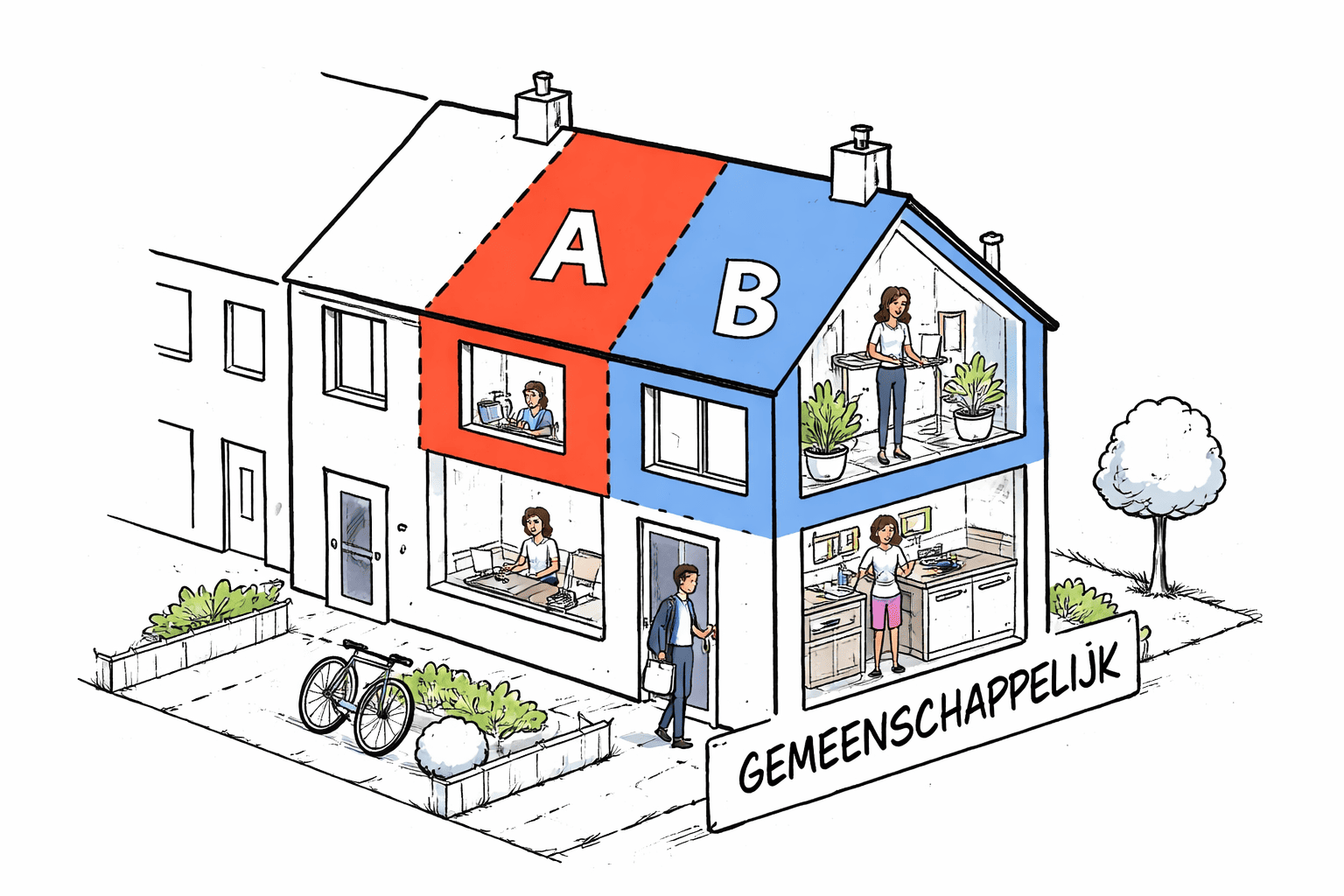
Home sharing, where two or more households share a single home, is viewed by the cabinet and experts as a quick solution to the housing shortage. However, in practice, this has only gained limited traction. Municipalities play an important role in this, but their rules vary widely and often pose an obstacle.
According to Frank Wassenberg of knowledge institute Platform31, many municipalities are open to shared housing, but implementation lags behind. It was agreed in the coalition agreement that shared housing and renting out rooms must become easier. Municipalities may only restrict this for compelling reasons, and rules for dividing homes into separate units must be simplified.
There seems to be a lot of potential: within the current housing association, some 60,000 homes are said to be suitable for sharing. In reality, these numbers are nowhere near being achieved. Private landlords also face obstacles.
A major cause is the mismatch between homes and households. It appears that home size and household size do not align well. On average, the Dutch live spaciously, with about 53 square meters per person. At the same time, the number of single-person households has risen sharply to 3.4 million. This is more than double the number from 50 years ago. 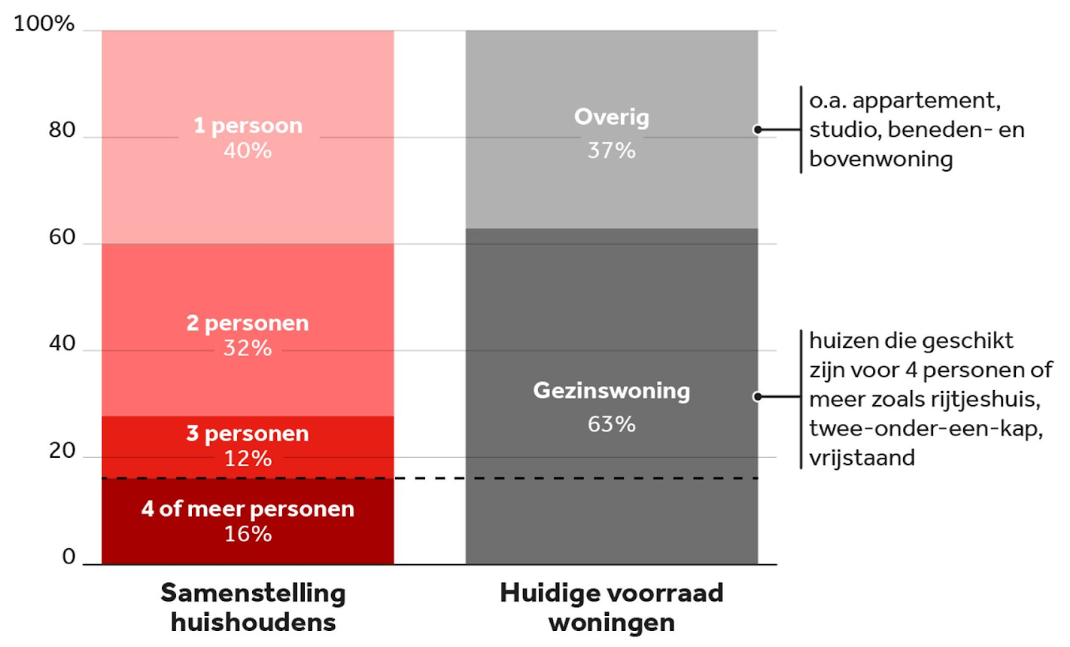
According to real estate professor Piet Eichholtz, this is precisely where an opportunity lies, for example in cities where older buildings offer space for additional housing in, say, communal attic spaces. However, municipalities must permit this, and that is far from always the case.
Regulations regarding parking and livability often pose a problem. For instance, parking standards determine how many parking spaces are needed in a neighborhood. In shared housing, this standard is exceeded more quickly, even though this is not always necessary, for example in student neighborhoods. Additionally, municipalities fear nuisance, such as noise pollution and congestion in the neighborhood. Some municipalities, such as Beverwijk, have therefore actually tightened the rules.
The approach varies significantly by municipality. Nijmegen has relaxed its policy and is working on options to rent out three rooms without a permit. Arnhem is more cautious and is still investigating what is possible for housing corporations, partly due to previous problems with nuisance and unsafe situations.
The central government also plays a role. Schemes such as housing allowance and the cost-sharing standard make shared housing less attractive, especially for people receiving benefits or a state pension. Therefore, adjustments are being considered, such as relaxing these rules and making renting out rooms in lodgers more appealing.
In short: although shared housing offers opportunities to alleviate the housing shortage, divergent regulations and interests prevent it from happening on a large scale yet.
Contact
iQ Makelaars Groningen
Kraneweg 23
9718 JD Groningen
 groningen@iqmakelaars.nl
 050 - 760 17 77
Openingstijden
Maandag t/m vrijdag 9.00 - ca. 17.30 u Zaterdag: 10.00 - ca. 16.00 u.
Huis verkopen
Over ons
Overig
Volg ons
Onze beoordelingen
Onze klanten beoordelen ons met een 9,6 / 10. Elke klant met een unieke ervaring. Benieuwd naar de verhalen?